How to Score a Buck: A Step-by-Step Guide to Scoring Whitetail Antlers

You finally got him on the ground. After the photos and the handshakes, there's one question everybody asks: what does he score? The good news is that scoring a buck is easier than it looks. With a scoring tape, a cable, a pencil and about 20 minutes, you can put an accurate green score on your deer at home, in camp or right on the tailgate.
This guide walks you through how to score a whitetail buck step by step using the Boone and Crockett system, the standard that nearly every record book and state program uses. We'll cover the tools you need, every measurement on the score sheet, the difference between gross and net score, and a full example so you can check your math.
What You Need to Score a Buck
- A steel scoring tape for straight measurements like inside spread. Our Whitetail Co. 72" Antler Scoring Tape is pocket-sized and lives in the truck, so it's there when you need it.
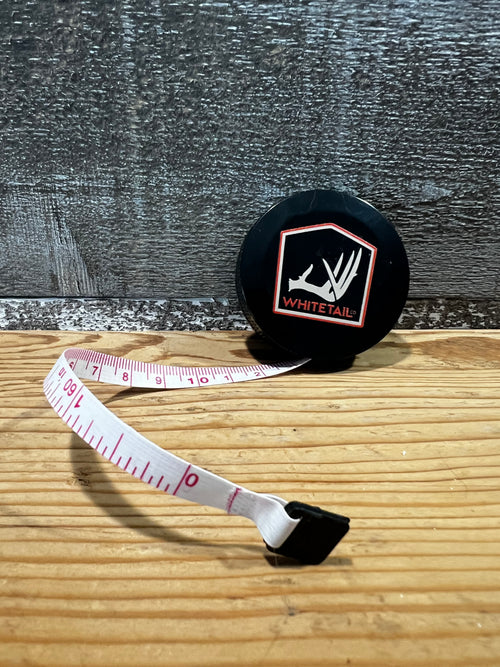
- A flexible cloth tape for circumference measurements. The Whitetail Co. Cloth Scoring Tape wraps tight around the beam and locks in place.
- A scoring cable or a piece of flexible wire for anything that curves, like main beams and long tines. It follows the curve of the antler so you get the true length instead of a guess.
- A pencil, paper and a score sheet to record each measurement as you go.
Want to skip the math? Plug your measurements into our Score My Buck calculator and it will total the score for you.
Scoring Basics Before You Start
- Measure to the nearest 1/8 inch. Scores are written in eighths, like 22 3/8.
- Know what counts as a point. Boone and Crockett defines a point as any projection at least one inch long that is longer than it is wide at one inch or more of its length. Anything shorter doesn't count as a point.
- Typical vs. non-typical. Typical points grow off the top of the main beam in the normal pattern. Abnormal points are everything else: drop tines, stickers, kickers and split brows. A typical buck has its abnormal points subtracted. A non-typical buck has them added.
- Letters on the score sheet. On the score sheet, F is main beam length, G is point length (G1 is the brow tine, G2 the next point up and so on), and H is circumference.

How to Score a Buck in 7 Steps
Step 1: Measure the inside spread
Measure the widest distance between the main beams, on the inside, at a right angle to the center line of the skull. Use your steel tape and keep it level and straight across. This number only counts once. Your spread credit can't be more than the length of the longer main beam. If the spread is wider, use the longer main beam length instead.
Step 2: Measure the main beam length
Start at the lowest outside edge of the burr, where the antler meets the skull, and run your cable along the outer curve of the beam all the way to the tip. Clip or pinch the cable at the tip, then lay it flat against your tape to read the length. Do this for both sides.

Step 3: Measure the length of each typical point
Each typical point (G1, G2, G3 and so on) is measured from where it leaves the top of the main beam to its tip. To find the starting spot, lay a strip of tape or your cable along the top edge of the main beam and mark the baseline under the point. Then measure from that line to the tip, following any curve with the cable. Record each point for both sides.
Step 4: Measure the four circumferences on each side
Every whitetail gets four circumference measurements per side, called H1 through H4, no matter how many points it has. Wrap the cloth tape around the beam at the smallest spot in each location:
- H1: between the burr and the brow tine (G1)
- H2: between G1 and G2
- H3: between G2 and G3
- H4: between G3 and G4
If a point is missing, use the halfway point instead. For example, on an 8-pointer with no G4, take H4 halfway between G3 and the tip of the main beam. The most common mistake here is measuring the thickest spot instead of the smallest one.
Step 5: Measure any abnormal points
Measure every abnormal point from where it leaves the antler to its tip and add them up separately. Keep this total on its own line because it gets subtracted for a typical score and added for a non-typical score.
Step 6: Add it up for the gross score
Add the inside spread credit, both main beams, every typical point length and all eight circumferences. That total is your buck's gross typical score, the number most hunters talk about at camp. Our Score My Buck calculator will add it up for you.
Step 7: Subtract the deductions for the net score
Boone and Crockett rewards symmetry. For each matching pair of measurements (right beam vs. left beam, right G2 vs. left G2, right H1 vs. left H1 and so on), subtract the difference between the two sides. Then subtract any abnormal points. What's left is your net typical score.
For a non-typical buck, start with the net typical score and add the total length of the abnormal points back in.
Example: Scoring an 8-Point Buck
Here's a sample 4x4 so you can see how the math works. All numbers are in inches.
| Measurement | Right | Left | Difference |
|---|---|---|---|
| Main beam (F) | 22 | 21 4/8 | 4/8 |
| Brow tine (G1) | 4 | 3 4/8 | 4/8 |
| G2 | 9 | 9 4/8 | 4/8 |
| G3 | 7 | 6 4/8 | 4/8 |
| H1 | 4 4/8 | 4 4/8 | 0 |
| H2 | 4 2/8 | 4 2/8 | 0 |
| H3 | 4 | 4 1/8 | 1/8 |
| H4 | 3 6/8 | 3 6/8 | 0 |
| Side totals | 58 4/8 | 57 5/8 | 2 1/8 |
- Inside spread: 17
- Gross score: 17 + 58 4/8 + 57 5/8 = 133 1/8
- Deductions: 2 1/8 (no abnormal points)
- Net typical score: 133 1/8 − 2 1/8 = 131
Quick field trick: on a balanced typical rack, score one side, double it and add the inside spread. You'll land within a few inches of the real gross score.
Green Score vs. Official Score
The score you put on your buck right after the hunt is a green score. Antlers shrink a little as they dry, so an official score can only be taken after the rack has air-dried for at least 60 days. Official scores are recorded by a certified measurer. If you think your buck might make the book, here are the minimum scores to know:
| Record book | Typical | Non-typical |
|---|---|---|
| Boone and Crockett (All-Time) | 170 | 195 |
| Boone and Crockett (Awards) | 160 | 185 |
| Pope and Young (archery) | 125 | 155 |
Many states also keep their own record books with lower minimums, so check with your state wildlife agency too.
Common Scoring Mistakes
- Using a rigid tape on curves. A straight tape cuts corners and shorts your buck. Use a cable for beams and long tines.
- Measuring the thickest spot for circumference. H measurements always go at the smallest point between tines.
- Starting tine measurements at the wrong spot. Measure from the top edge of the main beam, not from the side or the bottom.
- Counting nubs as points. If it's not at least an inch long and longer than it is wide, it's not a point.
- Forgetting H4. Every side gets four circumferences, even on a 6- or 8-pointer.
Frequently Asked Questions
What is a good score for a whitetail buck?
It depends on where you hunt. In much of the country, a buck that scores in the 120s or 130s is a great deer. Anything over 140 is a true wall-hanger. Bucks that reach 160 or higher are rare anywhere.
What's the difference between gross and net score?
Gross score is the total of every typical measurement added together. Net score subtracts the differences between the left and right sides and any abnormal points. Most hunters talk about gross, and record books use net.
Can I score sheds?
Yes. You can measure the beam, tines and circumferences on a single shed the same way. If you find both sides, you can estimate the full rack by adding an estimated inside spread.
Do I need special tools to score a buck?
You can get close with a regular tape measure and a piece of string, but a steel scoring tape, a flexible cloth tape and a cable make it faster and far more accurate, especially on curved beams.
Score Your Buck the Right Way
Every inch matters when you're scoring a deer you worked all season for. Keep a Whitetail Co. Scoring Tape in your truck, add a cloth tape for the circumferences, or browse our full antler scoring collection. Then run the numbers in our Score My Buck calculator and tag us on Instagram at @whitetail_company. We'd love to see what he scored.